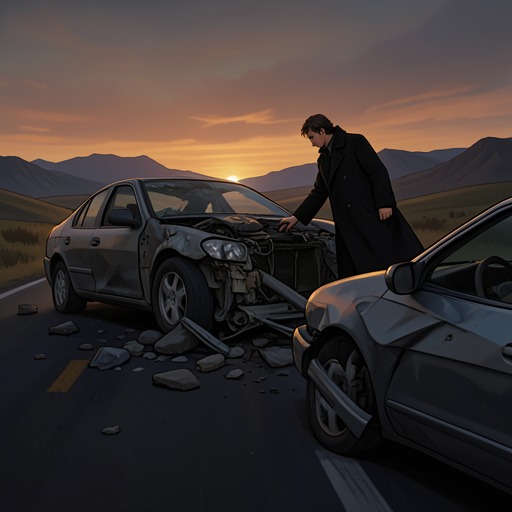
Morning Glory's hit at the Fujisawa intersection
Bullet TrainMorning Glory’s hit at the Fujisawa intersection is a calculated attack disguised as an accident: after studying the crossing and selecting a target, Morning Glory touches a man’s back at the moment traffic surges, sending him into the path of a vehicle. The scene turns the apparent folklore of the Pusher into a methodical act of violence, while its echo of an earlier attack at the same intersection reveals a disturbing recurrence.
The crossing and the method
At the main intersection in Fujisawa Kongocho, Morning Glory waits thirty metres from the crossing, in front of a chain bookstore. He watches the traffic light and the people gathering at the kerb, sorting passers-by by broad characteristics—men and women, height, build, age, even whether someone is wearing a school uniform. The repetition of these rejections makes the scene resemble surveillance: he is not simply watching a crowd but waiting for a person who fits a purpose.
The signal gives him another kind of information. He observes how long the pedestrian light stays on and how the traffic behaves as the sequence changes. His attention fixes on the transition from green to yellow and then red: cars, he notes, move faster on yellow, when drivers abandon caution and charge forward. The crossing is therefore both a public space and a timing mechanism. Morning Glory studies its ordinary rhythm for the moment when a pedestrian can be made vulnerable within it.
A previous attack at the same intersection
Before the new target appears, Morning Glory recalls a woman who had questioned him about the Pusher. She had compared the figure to a kamaitachi, a spirit blamed for sudden cuts that might otherwise seem to come from nowhere, and wondered whether people invented the Pusher to explain accidents. Morning Glory rejected that explanation: in his account, blaming the wind was itself the invented story. The exchange establishes that he knows the difference between a seeming accident and the violence concealed beneath one.
The woman was trying to hire him and continued questioning him after he turned down the job. Morning Glory came to dislike her; when she stubbornly followed him, he pushed her into the road as the light was about to turn red. A pickup truck struck her. His only stated regret was that he had done the job for no fee. That earlier incident makes the present attack more than an isolated assault: the same intersection has already been the setting for a deliberate push into traffic, and Morning Glory carries no expressed remorse for either victim.
The man at the crossing
Morning Glory’s attention settles on a passing man in his forties: short, broad-shouldered, with short hair and a pinstriped grey suit. He follows him toward the intersection. The man joins the people waiting for the walk signal, and Morning Glory follows into the same flow. Although he is aware of what he is doing, his movements seem not quite his own to him, a momentary estrangement that accompanies rather than interrupts his approach.
When the traffic light changes from green to yellow, the man stops at the edge of the crossing. Cars come from the right. Morning Glory notices a black minivan driven by a short-haired woman, with a child seat in the back, but judges the timing wrong. Another minivan of the same type happens to follow it. As the light changes, that car surges forward. Morning Glory moves casually and touches the man’s back. The smallness of the gesture contrasts with the violence it initiates: he does not need to seize the man or openly struggle with him, only to act at the instant traffic and pedestrian movement converge.
Impact and departure
The collision registers first as sound: impact, then tyres screeching against the road. The people around the crossing do not immediately scream. Their shock is described as a silent, transparent explosion, an image that makes the crowd’s sudden collective recognition visible without giving it a voice. The scene offers no confirmation of the man’s eventual condition, so the impact is clear but its final medical outcome is not.
Morning Glory is already gone. He walks back the way he came, fluidly, as though carried by a current. Cries for an ambulance follow behind him, but they do not disturb his calm. His attention drifts instead to the vague recollection that he once did a job at this same intersection. The passing thought links the present assault to the earlier killing without turning either into an accident: each is an act Morning Glory has committed, then left behind while the people around him face its consequences.
Recurrence and significance
The event exposes the Pusher not as a supernatural force or a convenient name for random misfortune, but as a person who engineers the appearance of chance. Morning Glory first describes the mistaken belief that a sharp wind causes unexplained cuts, then applies the same logic to a far more consequential violence: a shove can be hidden inside the unpredictable motion of traffic. His knowledge of the signals, his choice to follow a particular man, and his adjustment when the first vehicle’s timing is wrong all make the act intentional.
The repeated intersection binds the two attacks together. In both, Morning Glory pushes a person into the road as the traffic signal changes; in both, ordinary movement provides cover for a chosen act. Yet the present scene also ends on a note of practiced detachment rather than triumph. An ambulance is called, the crowd remains behind, and Morning Glory leaves with only a hazy memory of having worked there before. The violence recurs; responsibility, in his own mind, scarcely seems to remain.